Golin press brake tooling is designed for those who demand the best and have exacting standards. All press brake tooling is manufactured from premium tool steel with the “business end” of the punch induction heat treated for extra
durability.
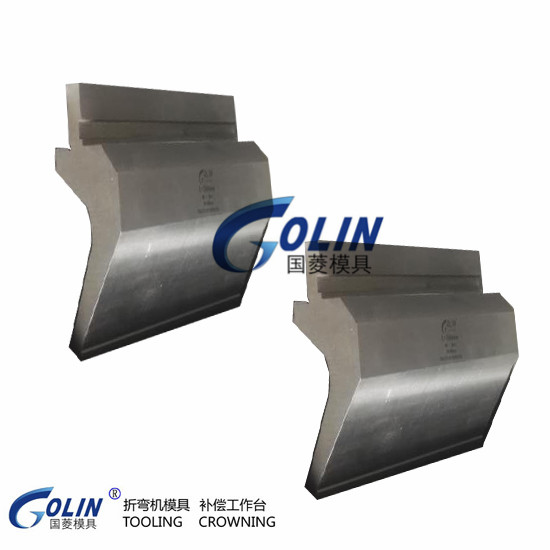
Golin press brake tooling is designed for those who demand the best and have exacting standards. All press brake tooling is manufactured from premium tool steel with the “business end” of the punch induction heat treated for extra
durability.
Enterprise resumption statement
During the Spring Festival in 2020, we spent a special holiday. Although facing disasters,unity is strength.The people of the whole country resist the sudden COVID-19 virus. colleagues actively respond to the call of the state and isolate at home.Our company was originally scheduled to start on February 2nd.According to the policy requirements, we would work online or at home.With the improvement of these days and the permission of relevant departments.Now, our company officially has resumed work , and employees arrived one after another.We must implement employee plague protection work and process remaining orders in time on the premise of ensuring safety t of the year. At present, we will try our best to meet customer ordering requirements for new orders. Welcome azonal clients to calculate the delivery period and place orders for stocking as soon as possible.
Maanshan Golin Press Brake Tooling Co.,ltd
...In the world of precision engineering and metal fabrication, the right tooling can make all the difference. At Golin, we specialize in crafting exceptional bending machine molds that cater to the diverse needs of manufacturers across industries. Our commitment to excellence, innovation, and customer satisfaction has positioned us as a leading player in the market. Here are five compelling reasons why you should consider Golin for your next project.
Golin Molds boasts decades of experience in designing and manufacturing bending machine molds. Our team of engineers and technicians possesses deep knowledge of materials science, metal forming processes, and precision machining. This expertise enables us to create molds that not only meet but exceed industry standards. Whether you're working with stainless steel, aluminum, or high-strength alloys, our molds deliver consistent results, ensuring accuracy and reliability in every bend.
Our product line includes several classic models that have become industry favorites. The Golin G-Series, for instance, is renowned for its versatility and durability. These molds are engineered to handle a wide range of bending angles and thicknesses, making them ideal for both small-scale production runs and high-volume manufacturing. The G-Series' robust construction and precision-ground surfaces ensure long-term performance and minimal maintenance, reducing your overall operational costs.
Golin Molds are known for their exceptional performance characteristics. Our molds are designed to minimize wear and tear, even under heavy-duty applications. The use of advanced materials and heat-treatment processes ensures that our molds maintain their sharpness and dimensional stability over extended periods. Additionally, our molds are easy to install and adjust, saving you time and effort on the shop floor. The smooth, polished surfaces of our molds also contribute to better material flow and reduced friction, leading to improved part quality and longer tool life.
At Golin , we understand that the user experience is paramount. That's why we prioritize customer support and after-sales service. Our dedicated team is always available to assist you with technical queries, mold selection, and troubleshooting. We also offer training programs to help your team maximize the potential of our molds. Furthermore, our molds come with comprehensive warranties and flexible maintenance contracts, giving you peace of mind and ensuring uninterrupted production.
Golin have been instrumental in the success of numerous projects across various industries.Our collaboration with leading manufacturers has resulted in innovative solutions that have pushed the boundaries of metal forming technology. Case studies and testimonials from satisfied customers showcase the tangible benefits of choosing Golin Molds, including improved productivity, reduced downtime, and enhanced part quality.
We are offering a wide range of Metal Forming Dies to our customers. Our Metal Forming Dies are made by good quality raw materials. These are known for its good quality and durability.
High strength
Generally,the material of press brake die inlcuding T8 steel, T10 steel, 42CrMo,and Cr12MoV.
Cr12MoV is also good material.The using performance can be satisfied,the process performance is also good,but the price will be high.
42CrMo is a high strength alloy quenched and tempered steel with high strength and strong toughness.It can work ubder the temperature of-500℃.
It mainly requires high strength,high toughness,and good wear resistance.
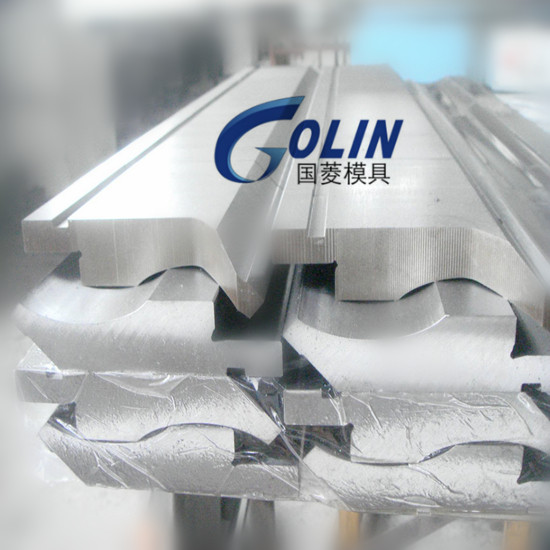
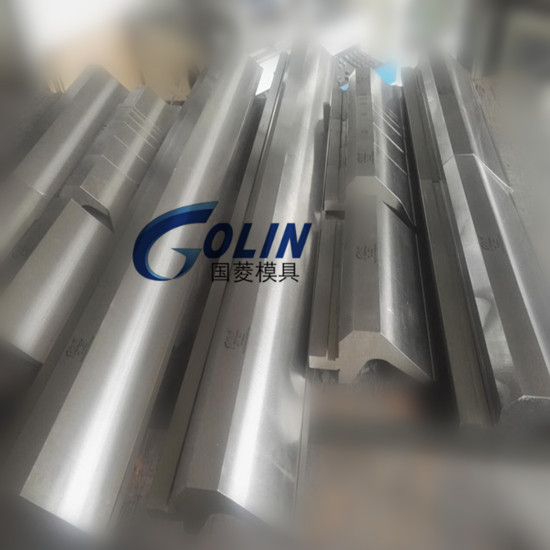
When selecting a press brake tooling, the following factors need to be considered:
1. Material type: It is very important to determine the type of material you will be bending. Different materials require different types of molds to complete bending operations. Common materials include steel plates, aluminum plates, stainless steel plates, etc. Ensure that the selected mold is suitable for the type of material you want to handle.
2. Bending angle and radius: Determine the bending angle and radius you need to achieve. Different molds have different curve shapes and bending angle limitations. Ensure that the selected mold meets your specific needs.
3. Mold quality: The quality of the mold directly affects the bending results and the service life of the mold. Choosing high-quality molds can improve work efficiency and reduce mold wear.
4. Manufacturer reputation: It is very important to choose a reputable mold supplier or manufacturer. They can provide high-quality molds and good after-sales service.
5. Cost: The price of the mold is another factor to consider. Choose suitable and cost-effective molds within the budget range.
Before making a purchase, it is best to communicate with the mold supplier or manufacturer, inform them of your needs, and seek their advice. In addition, you can visit some mold exhibitions or related industry forums to learn about the latest developments and technological trends in the market, to help you make wiser choices. Cngolin is a professional press brake tooling manufacturer,get more details from us quickly!
What are the upper and lower tools of the press brake ? Let's see how the tools are classified
1. The press brake tools include L-shaped, R-shaped, U-shaped, and Z-shaped press tools.
2. The upper tool of the press brake has different angles of 90 degrees, 88 degrees, 45 degrees, 30 degrees, 20 degrees, and 15 degrees. The lower tool is generally divided into 400mm, 200mm, 100mm, 50mm, 40mm, 20mm, 15mm, 10mm, totaling 835mm.
3. The lower tool of the press brake has 4~18V double groove and single groove, with different groove widths, as well as R lower tool, sharp angle lower tool, flattening tool, etc.
4. The upper and lower tools are divided into sections and overall: the upper tool is generally divided into 300mm, 200mm, 100mm, 100mm, 50mm, 40mm, 20mm, 15mm, 10mm, and the overall size is 835mm.
Six characteristics of press brake tools
1. The press brake tool is made of steel and undergoes special heat treatment. It has the characteristics of high hardness, low wear resistance, and high pressure resistance. But each set of tools has its ultimate pressure: tons per meter. So when using a tool, the length of the tool should be selected, that is, how much pressure should be added per meter, and the pressure should not exceed the pressure indicated on the tool.
2. In order not to damage the tool, we stipulate that upper and lower tools with a length greater than 300mm must be used for the origin. After the origin correction, upper and lower tools of the same height can be used. It is strictly prohibited to use separated small modules to execute the origin, and the origin must be based on the origin pressure inside the AMADA machine.
3. When using tools, due to the different heights of various tools, tools of the same height can only be used in the machine, and tools of different heights cannot be used.
4. When bending sharp corners or pressing dead corners, choose 30 degrees, first bend the sharp corner, and then press the dead corner. When bending the R angle, the R upper tool and the R lower tool should be selected.
5. When bending a long workpiece, do not use a parting die to reduce the indentation of the tool. Instead, choose a single groove because the outer angle R of the V-shaped groove in the lower tool of the single groove is relatively large, making it difficult to generate indentation.
6. When selecting the upper tool, we should know all the parameters of the tool and then decide what to use based on the shape of the product we need to shape
Get more press brake tooling from www.cngolin.com.The relationship between the notch width of the lower die of the CNC bending machine mold and the plate thickness is a question that many metal processing manufacturers will ask. Now the recognized calculation formula in the market is: V groove width = plate thickness *8. This is a common calculation formula in the market, but it also hides a disadvantage. For workpieces that require precision, is this formula still applicable? The result is that it does not completely match. Because this formula is only suitable for precision bending, not for suspended bending and close bending. At the same time, the ratio of the width of the lower die groove of the bending machine to the plate thickness required by different materials is not necessarily the same.
According to the data summarized according to market requirements, the plate thickness t: o~3mm plate, the notch width of the lower die of the bending machine V=plate thickness t*6, precision bending can be narrowed to 4 times the plate thickness: 3~10mm plate , the notch width of the lower die of the bending machine V=plate thickness t*8; for plates above 10mm, the notch width of the lower die V=plate thickness*12. The above are common calculation methods in the market. According to the experience of CNC bending machine mold manufacturers for many years and the processing experience of Lingjin Factory, this formula is usually suitable for precision bending. For suspended bending and tight bending, the relationship between the width of the corresponding lower die slot and the multiple of the plate thickness can be appropriately reduced. If the processing plate is aluminum, the width of the slot of the lower die of the CNC bending machine V=thickness t*6 can meet the processing requirements, and it also means that when processing aluminum, the material and hardness of the lower die of the bending machine must be The mold requirements are higher than ordinary materials, and the R angle of the notch must be more than 1.5mm, so that the damage to the workpiece during bending is less, and the indentation is relatively shallow.
If the processing method is suspended bending or closed bending, the notch of the lower die of the bending machine mold can be reduced accordingly, because the bending method does not require the upper and lower dies to be pressed to form. Reducing the width of the notch will also make the angle of the processed product more beautiful. The width of the bending notch also determines the size of the R angle at the corner of the workpiece. If you want the processed product not to form an R angle, it is best to plan grooves at the bending point before processing, so that the processed rice metal parts will have very standard bending angles and no R angle will affect the appearance. Therefore, the width of the notch of the lower die of the CNC bending machine should be reasonably designed and produced according to the accuracy of the product, the material of the product, and the bending angle of the product, rather than simply calculated based on the thickness of the sheet. This is neither scientific nor It is not in line with common sense. According to the product requirements, choose the most suitable notch of the lower die of the CNC bending machine, and the product qualification rate will be higher.
...CNC press brake is an important equipment in sheet metal processing, and its working accuracy directly affects the bending accuracy of the workpiece. Why add a compensation system to the CNC press brake during the workpiece bending process, as the maximum force is exerted on both ends of the slider and the reaction force during sheet bending causes concave deformation on the lower surface of the slider.
Why does the CNC press brake need to add a compensation system
In order to eliminate the adverse effects of slider deformation, it is necessary to compensate for the deflection deformation of the slider. The usual compensation methods include hydraulic compensation and mechanical compensation, both of which generate upward elastic deformation in the middle of the Compensation workbench to offset the deformation of the machine tool slider, ensure the accuracy of the machining joint surface, and improve the accuracy of the workpiece. At present, major foreign machine tool manufacturers use mechanical compensation devices; Domestic manufacturers will choose appropriate compensation methods based on the actual situation.
Introduction to Two Compensation Methods
Hydraulic compensation method
The hydraulic automatic deflection compensation mechanism of the worktable is composed of a set of oil cylinders installed in the lower worktable. The position and size of each compensation cylinder are designed based on the deflection compensation curve of the slider and the finite element analysis of the worktable. Hydraulic compensation is achieved through the relative displacement between the front, middle, and rear three vertical plates to compensate for the protrusion of the neutral plate. Its principle is to achieve protrusion through the elastic deformation of the steel plate itself, So its compensation amount can be adjusted within the elastic range of the workbench.
Mechanical compensation method
Mechanical compensation is composed of a set of convex wedge blocks with inclined surfaces, each of which is designed based on the deflection curve of the slider and worktable finite element analysis. The CNC system calculates the required compensation amount based on the magnitude of the load force during the bending of the workpiece (which will cause deflection deformation of the slider and worktable vertical plate), automatically controls the relative movement of the protruding wedge block, and effectively compensates for the deflection deformation caused by the slider and worktable vertical plate. The ideal bending workpiece mechanical deflection compensation is achieved by controlling the position to achieve "pre protrusion", A set of wedges forms a curve in the length direction of the workbench that matches the actual deflection, ensuring that the gap between the upper and lower molds is consistent during bending, and ensuring that the angle of the bent workpiece in the length direction is consistent.
Comparison of Two Compensation Methods
The advantages of hydraulic compensation:
As time goes by, hydraulic compensation does not have any wear issues, while mechanical compensation screws, wedge-shaped blocks, etc. will experience wear over time.
Hydraulic compensation takes up less space, while mechanical compensation takes up more free space in both height and width directions.
When using hydraulic compensation, the plate cannot be displaced because the lower workbench is in contact with the ground of the bent plate as a whole, and the positioning of the stop finger is very stable when it contacts the "clamping point" of the plate horizontally. Mechanical compensation only takes effect after bending, and there is a possibility of unpredictable errors.
Hydraulic compensation can also be adjusted when the workpiece is not removed, which is impossible in mechanical compensation.
The advantages of mechanical compensation:
Mechanical compensation has long-lasting stability and reduces the difficulty and frequency of hydraulic compensation maintenance (such as oil leakage caused by seal ring damage), and is maintenance free during the service life of the machine tool.
Mechanical compensation, due to the large number of compensation points, can achieve precise deflection compensation throughout the entire length of the workbench, making it easier for the press brake to achieve linear compensation when bending workpieces during operation, and improving the bending effect of workpieces.
Mechanical compensation is the use of a potential ruler to measure the position of the return signal, which serves as a CNC axis to achieve digital control and make the compensation value more accurate.
Problems encountered when using CNC press brake
When we use the CNC press brake to work, there is a high possibility of some error problems. At this time, we need to pay attention and check immediately if there are any problems. The first step of inspection is to check if there is any wear or damage to the mold currently used by the press brake. If this is the cause of the error, then replace the mold.
However, during the inspection process, if no damage is found, the second step is to check the balance between the slider and the workbench. If the site cannot meet the usage requirements, adjustments must be made according to relevant standards to ensure that this parallelism can be maintained within the standard range.
If there is still a certain degree of error in the angle of the workpiece, it may not be due to the mold or parallelism, but it may be due to the hydraulic system of the equipment, where the balance mechanism does not ensure that the pressure oil evenly enters the left and right cylinders, and adjustment is needed.
At this point, it is necessary to adjust the working mode of the press brake to the "jog adjustment" state. Remove the mold or other accessories from the equipment, so that the slider can stay on the mechanical block. Then, adjust the pressure gauge correctly by compressing the dial gauge head of the press brake by 3-4 millimeters, stepping on the foot pedal to increase the system pressure. When the press brake system is pressurized or unloaded, Check the clockwise deviation of the dial gauge. If it reaches the specified value, the operation can be stopped. Of course, in addition to the above methods, it should be emphasized that the press brake must be well maintained to maximize its advantages in use.
...Modern composite materials have transformed personal protective equipment (PPE) manufacturing...
Our basalt-based composite solutions demonstrate exceptional impact resistance...
The unique layered structure combines basalt fibers with polymer matrices...
We offer tailored material combinations for specific applications...
Eco-conscious manufacturing processes reduce carbon footprint...
All materials meet international safety standards including...
Ready to upgrade your helmet technology?
Request Technical ConsultationOr contact our specialists: +xxx-xxx-xxxx
...